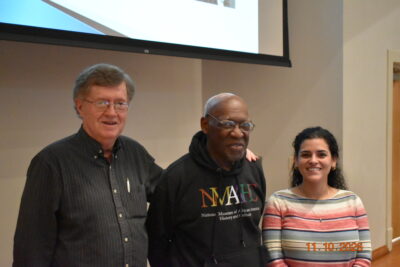

I’ve had the privilege of attending two events this semester hosted by Mennonite Central Committee focusing on peace. The first was in Chicago; a “Faith in Action” peace camp hosted in collaboration with Mennonite Action. The second was the MCC U.N. student seminar, “Multilateralism: The Path to Peace in a Divided World.”
One thing that I’ve taken away from both of these experiences is the need for hope. While in Chicago, we heard from Nathan Perrin, a pastor and human rights advocate. He said that hope and spiritual grounding are the core of activism.Change is a long-term effort. To sustain the hard work of peacebuilding and change making, you need a strong foundation of hope. For a lot of people this is found through their faith, through community or through relationship with one another.
Perrin also brought up the Palestinian idea of “Sumud” or steadfastness. It represents a sustained and intentional resistance from Palestinians to the Israeli occupation, and prioritizes non-violent civil disobedience. After decades of colonization and genocide, Palestinians still have hope.
The wave of progressive candidates elected during the midterms is a step in the right direction. It shows that people are fed up with the current administration and care enough to do something about it. However, this is not the end goal.
No one is free, until everybody is free. This is a sentiment you’ve probably heard from Maya Angelou or Martin Luther King Jr. It’s not new but it’s still relevant.
I heard this sentiment reiterated while I was at the MCC U.N. seminar from Rev. Dionne P. Boissière, the chaplain at the Church Center for the U.N. She said that our individual liberation is tied up in the liberation of the collective. We are on a path towards liberation, but we can’t walk it alone.
Boissière talked about doing justice work with the Church Center and other grassroots organizations. She said, “If you don’t feel the pain of injustice you’re doing it wrong.”
We still live in a society built on systems of oppression — systems of colonization, white supremacy and patriarchy. We remain complicit in these systems when we don’t actively resist them. In some contexts we may even benefit from these systems. That does not mean we are exempt from the consequences.
The pain of injustice persists as we face the consequences of systems that weren’t built for us, and as we stand in solidarity with others who are living in a system that wasn’t built for them. No one is free until we are all free — until the systems of oppression are rebuilt.
As we seek peace, justice and liberation, we know there will be pain, but we must sustain ourselves with hope.
I find hope in the witness that the world keeps moving. I find hope in talking to people doing on-the-ground grassroots work from Chicago to New York City. I find hope laughing with my housemates during brunch and starting spontaneous jam sessions. I find hope in knowing that God is love.
Where do you find hope?