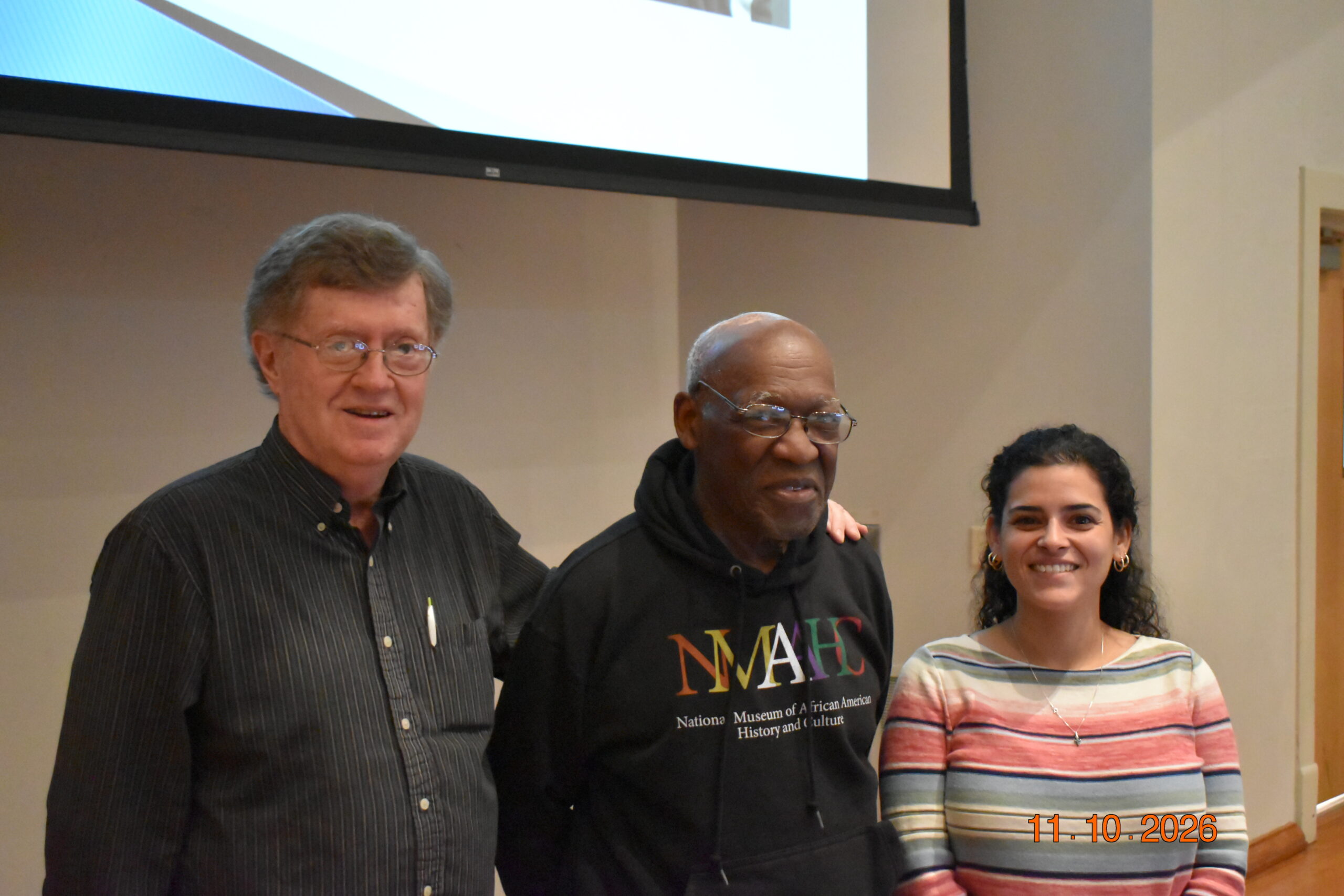
A new GLST course, Race in Elkhart County: Black Stories is now being offered to Goshen College students. This semester, the course is being taught by Alicia Maldonado-Zahra, GC’s scholar activist fellow, on Tuesdays and Thursday in the Administration Building.
With this course being taught for the very first time, Maldonado-Zahra wanted to ensure her students had a relatively similar understanding of Black history in the United States.Maldonado-Zahra started off the first half of the semester with a broader focus on general Black history in the U.S., with the plan of narrowing in on specific Black stories in Elkhart County after establishing a strong fundamental understanding.
“We can’t understand Black Stories in Elkhart County without understanding all the history,” Maldonado-Zahra said.
Some earlier class discussions included topics such as the Doctrine of Discovery, the idea of race and how it structures what the U.S. is today, slavery and slave rebellions, the Civil Rights Movement, and the Underground Railroad.
With the class now focusing more on Elkhart County, Maldonado-Zahra invited two guest speakers, Dan Shenk and Lee Roy Berry, to the class on Tuesday.
Dan Shenk, a local Mennonite historian, and Lee Roy Berry, a former Mennonite lawyer, are well known for their work in acknowledging the Black community in Goshen specifically, the acknowledgement of Goshen being a sundown town.
A sundown town is a community that excluded Black Americans from living there or staying in the town after dusk. This has been a long researched topic, and the City of Goshen has worked to acknowledge this fact and to make things right.
“There is a database from Tougaloo College, a historically Black college in Mississippi, called the Sundown Town Database, and there was a whole page just for Goshen,” Maldonado-Zahra shared.
Throughout the presentation, the speakers shared the process of forming the resolution, “A Resolution Acknowledging the Racially Exclusionary Past of Goshen, Indiana, as a ‘Sundown Town’”, which was officially passed by the Goshen Common Council in 2015.
“The fact that Goshen is now not nearly the Black population that Elkhart has — which is about 15-20% and Goshen is about 2-1/2% … but that is a lot better than the numbers that we were seeing in the 1900s,” Shenk said.
“It did start to increase, and so Goshen became a somewhat more welcoming place in the late 20th century but I think we’ve made even more progress in the 21st century,”
Shenk continued.
Berry echoed Shenk’s sentiment regarding the increased inclusivity and recognition of the Black population in the United States in recent years.
“It’s slow, and I’m not sure how fast it will continue to occur, but there are people who share the view that the United States is not just a white person’s country. It has lots of different people,” Berry said.
How can we make this right? What is Elkhart County doing to make this right? These are some of the questions being addressed as a part of this GLST course.
On Thursday, another guest speaker, Charles Walker, will be speaking on his experience growing up in the Jim Crow South, moving to Elkhart and his experiences with racism and discrimination.
Along with lectures, guest speakers, group discussions and presentations, the class also takes field trips that correlate with the topics the class has been covering.
Thus far, Maldonado-Zahra shared that the class has gone to the Tolson Center for a lecture titled “Origins of Empire,” to Cassapolis, Michigan for a tour of the Underground Railroad, to the Civil Rights Heritage Center in South Bend and to the Elkhart County Historical Museum.
Toward the end of semester, there will be another field trip to the Tolson Center, but, this time for a dinner with the elders from Benham West, a Black neighborhood that was demolished within Elkhart City.
Alaina Wolfe, a senior criminal justice major, said. “I think this class is really beneficial because it opens my eyes to the ways racism is so deeply rooted in American culture.”
“It’s in the economy, the criminal justice system, and even in the ways we perceive what justice is and who it should apply to,” she said.
This GLST course will be offered again in May term and will be taught by Maldonado-Zahra.