
I was scrolling through Substack the other day and I came across an article talking about what scrolling did to reading. As I reflected on that, I realized that higher education has become a model that needs urgent updating.
On one hand, professors give dense weekly readings and supplemental content. On the other hand, students either don’t do such activities and redirect it to AI, or resort to tools like skimming and playing recorded lectures at 2x speed. We are checking the boxes, but we aren’t actually learning. The current model of higher education treats the human brain like a storage container to be filled when in reality, it is a processor that is moving towards a breakdown. The issue is a misunderstanding of how we process knowledge.According to the article I read, in order to transform information into a memory, the brain requires a period of rest where neural connections are strengthened and the understanding of a concept, formula or a theory is solidified. Instead, higher education normally forces us to move immediately from one dense concept to the next without pause. We are drawing in wet sand just seconds before the tide comes in. By the time we sit down for class, the ‘waves’ of the next assignment have already washed away the last.
When faced with an impossible volume of content, our generation, which already has a shrinking attention span, does not know how to effectively cope and absorb the information.
This “content overdose” means that class discussions become unproductive. It’s hard to have a deep dialogue at a high academic level when half the room is operating on the watered down version of an AI summary of a source. Moreover, conceptual knowledge is not a passive result of information consumption. It is the result of active processing. For a concept to stick, a student needs time to go over it in their mind and apply it.
However, the weight of the next three chapters waiting on the desk prevents this. We are so busy “getting through” the material that we never actually “get” the material.
If we want to produce thinkers rather than just box-checkers, higher education must embrace the less is more mindset. If we cut the home content load and raise the time spent on processing activities, our generation may actually learn something.
This isn’t about dumbing down the curriculum; it’s about adapting to the on-going changes of the human brain in the digital era. We need to stop treating students like hard drives with infinite capacity and start treating them like carpenters who need time to polish their products. A student who deeply understands core principles of a topic will most likely outperform a student who has “read” ten chapters but can’t explain one. We need to give ourselves a chance to build something that won’t wash away by finals week.
In addition, this shift would also improve the quality of classroom engagement and participation. When students come prepared with a deeper understanding of fewer concepts, discussions naturally become more meaningful and dynamic. Instead of surface-level comments, students can ask better questions, challenge ideas and build on each other’s thoughts. This creates a more collaborative learning environment where knowledge is actively constructed rather than passively received. Over time, this kind of engagement not only strengthens comprehension but builds confidence, communication skills and the ability to think critically in real-world situations.
It would also encourage healthier academic habits and a more balanced relationship with learning. When students are not constantly overwhelmed by excessive workloads they have more time to reflect, review and truly engage with the material. This can lead to better retention, reduced stress and a stronger sense of purpose in their education. Instead of rushing to meet deadlines, students can focus on mastering concepts and developing skills that will stay with them long after graduation.
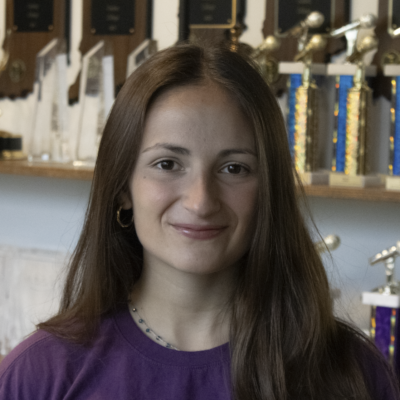
Isabel Massud is a senior film production major with minors in business and broadcasting from São Paulo, Brazil. She is part of the women’s soccer team as well as news director for 91.1 The Globe and student producer for FiveCore Media.