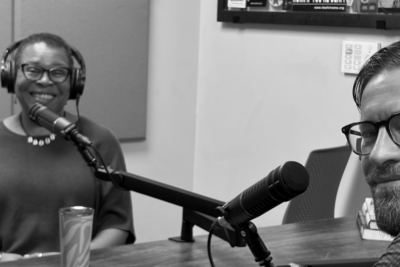
The Goshen College community gathered to watch the finals of the C. Henry Smith Peace Oratorical Contest on Feb. 17. This event featured five women whose words had earned them spots as finalists in the competition. But, how did they get there? Why did they enter the contest in the first place? What even is a peace oratorical contest?
This contest has been a part of GC’s campus culture since the early 1900s, and this one is simply the most recent iteration. Students present speeches on the theme of peace, in all its many forms, and are judged both on the content and the delivery of their speeches. This year, Isabel Massud, a senior film production major, won first prize with her speech, “Gender Safety: An Illusion of the Free World.” Caoimhe Farrell, a sophomore communication major, took second place, giving a speech on “Screens and Society.” The other finalists were Angelica Garcia-Ponce, a junior social work major, Mackenzie Miller, a junior communication major, and Shalom Solomon Teferi, a sophomore biochemistry and molecular biology major.The speeches presented in February had been in the works long before the public got to hear them. The first step in the long process is coming up with a topic. Massud said that her topic of domestic violence was the only thing she had when she decided to enter the contest. “As women, we know it’s not really easy to be a woman every day,” she said. “Even though I’m privileged enough to come from a background that protected me and raised me well so I know how to protect myself from situations, that’s just not a situation for everyone in the world.”
Other candidates were able to find topics directly related to their studies. Teferi, who plans to go into the medical field, ended up with a speech on “Healthcare as a Foundation for Peace.” “I’ve always been passionate about healthcare and the inequity that exists in healthcare,” she said. “Peace is just not the absence of violence but the presence of justice, and a huge part of justice is having equity. And I connected that with equity and healthcare.”
Once a topic is chosen, participants start writing. The first audition comes in the form of a five minute draft of a speech — half the length of the final product. Teferi said that writing this draft was the most difficult part of the process for her. “Just getting your ideas organized and putting it into an argument was a hard task for me,” she said. “Once you have a rough draft … adding onto it and expanding and changing it wasn’t as difficult.”
After these drafts were submitted, the five finalists soon discovered that they had been selected. The next step was to find a mentor, someone to coach you through the writing and presenting process. Massud chose Jessica Baldanzi, the chair of the English department. She said this choice was partially based on her comfort with the English language. “We had a lot of international students … but I was the only one that was raised in a different language,” she said. “I was just a little concerned about my delivery; if my pronunciation would get caught in some moments.”
Before the final competition, the speeches needed to somehow double in size, from five minutes to ten — about 1,500 words in total. However, students have access to a support system during the whole process. In addition to their chosen mentors, they receive feedback from Anna Groff, a communication professor and key player in the organization of the Oratorical Contest. In addition, all finalists met with a speech coach, who helped them with the delivery of the speeches.
Eventually, the finalists reached the night of the contest. For Massud, this presentation was the best part of the entire process. “Being able to be on stage and then having a mic and having people there to listen to me and my topic and being invested in it. I think it was the greatest part,” she said.
While none would describe this process as easy, these speakers recommend entering the competition to anyone interested. “Even if you think it’s a small idea, [your topic] will grow into something bigger than you expect. So just if you’re interested even a little bit in public speaking, just go for it. And you’ll have lots of support along the way to make it a great speech,” said Teferi. Massud echoed this statement, saying to “just do this for yourself, and whatever happens, happens, and maybe you win. I don’t know. That’s happened to me.”