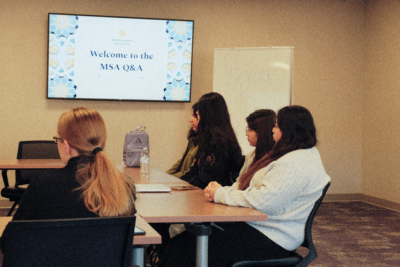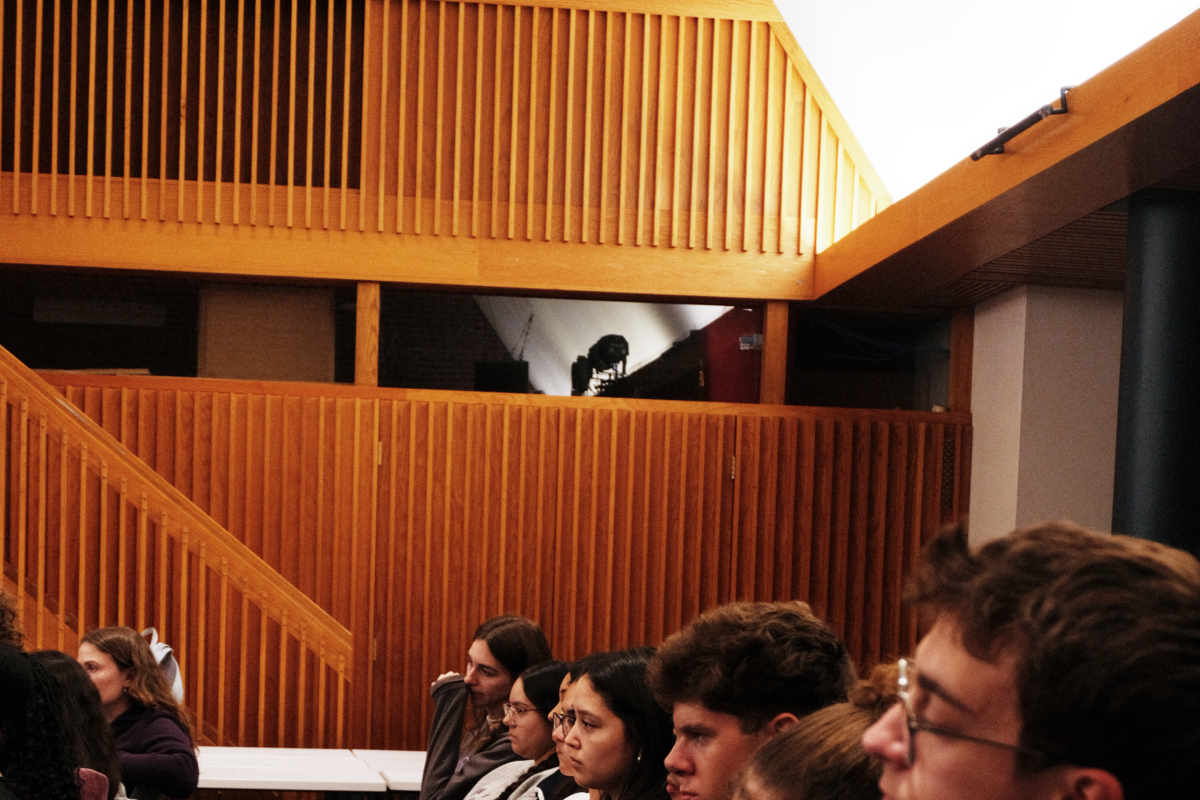

Goshen College’s Peace and Justice Collective hosted a workshop on healthy and constructive dialogues in Newcomer Center on Tuesday.
Jory Umble, sophomore nursing major and PJC leader, said that the purpose of this workshop was to “give people the opportunity to have constructive conversations or dialogue in meaningful ways in a space where we also provide a little bit of guidance and instruction.”The event began with intro activities. The main portion of the event consisted of a panel discussion and a facilitated peer-to-peer discussion activity. The event concluded with a short time for reflection.
The first half of the workshop consisted of panelists Regina Shands Stoltzfus, professor of peace justice and conflict studies; Alicia Maldonado-Zahra, GC’s scholar activist fellow and PJC faculty advisor; and Alicia McLeod, peace and justice coordinator with Mennonite Central Committee. The three shared on how to engage in healthy and constructive dialogues.
The panel was facilitated by Umble and Rose Snyder, a sophomore sociology major and PJC leader. Emotions in conflict, power dynamics in conflict and how to engage constructively in hard conversations were some of the topics discussed.
Following the panel, the workshop provided an opportunity for the GC community to engage in deeper conversations, connect across differences and voice their thoughts on contentious topics. This took place in the form of a quadrant activity.
Attendees were asked to place themselves in one of the four quadrants: strongly agree, strongly disagree, agree conditionally or other. PJC then shared the following two statements to respond to: “Engaging the Bible should be required” and “AI belongs in education.”
Josh Chupp, a sophomore social work major, appreciated this workshop. “People are a lot more in agreement than they think — it’s easy to polarize people without talking to them first,” Chupp said. “There are a lot of cases where people aren’t gonna judge you for not believing this or having your opinion on this.”
Attendees were encouraged to interact with each other across viewpoints through further discussion questions regarding their choices.
The questions motivated constructive disagreement and participants were given the opportunity to point out their agreements and disagreements with each other.
Attendees were spread across the quadrants on their responses regarding whether AI has a place in education.
“I think it’s important that we can see where the students who have their concerns are coming from and where the people who are incorporating AI into the school, where they’re coming from as well,” Chupp said.
Based on the positive reaction to this event, PJC may host a similar event in the future, with an aim to raise participation.
Umble said, “The conversations lasted — we had to cut things off.”
“People were really engaged in the topics. We can definitely expand the event; it has more potential for sure.”
Umble said, “Communication is really, really important in any aspect. … In the most basic form, peace and justice would be incredibly difficult to achieve without being able to converse with the people that you might have disagreements with.”