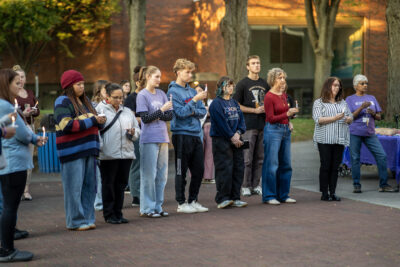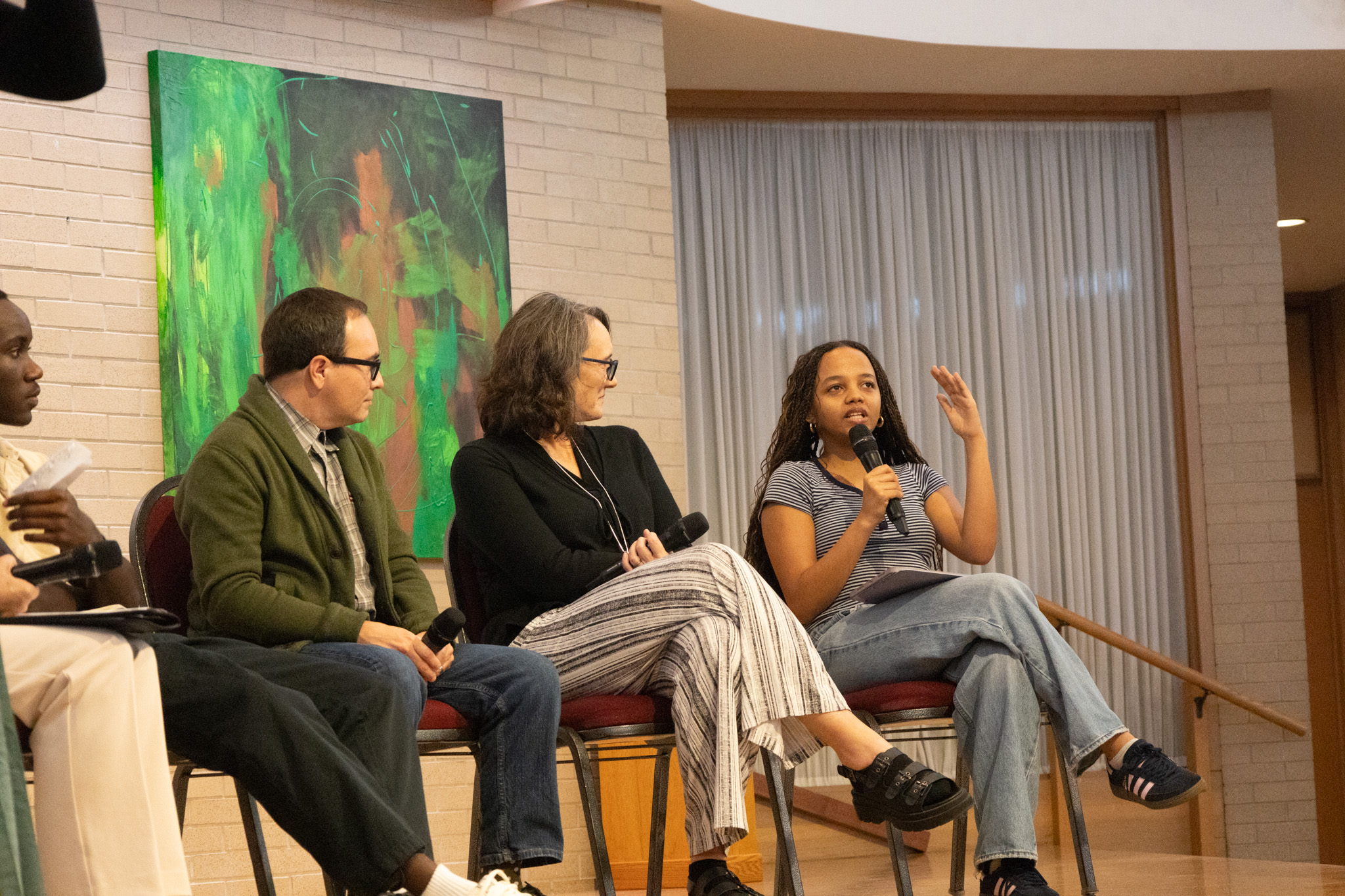

Students, faculty and staff of Goshen College gathered on Wednesday at the Church-Chapel for a convocation titled “GC’s AI Task Force: What We’ve Learned, Where We’re Going.”
The convocation took the form of a panel discussion which was moderated by dean Ann Vendrely. Faculty panelists were Michelle Blank, the senior director of the Academic Success Center, and Roy Jackson, an associate professor of education. Timothy Okiror, a sophomore computer science and engineering physics major and Shalom Teferi, a junior biochemistry and molecular biology major, represented students.Vendrely opened the discussion by asking the panel how they felt about AI a year ago versus how they feel about it today. Teferi said that she was intrigued a year ago and now she is cautious. Jackson has experienced the opposite, claiming that a year ago he was very cautious and is now optimistic. Okiror claimed to be “much more uncertain” and is now curious. Blank claimed to previously be intrigued, but believes it is now normalized.
Jackson explained that the CORE 110: Academic Voice: Speaking and Writing course, which he teaches, now has an AI unit. He also has just finished his dissertation and believed that his experiences with AI brought up questions about privilege.
“It’s very common for people in theses and dissertations to hire editors to edit their work, and that comes with economic privilege,” Jackson said. “And here is a tool that changes the playing field for those who don’t have economic privilege in life.”
Reflecting on her experiences on AI, Teferi explained that in her physics course, if she gets a detail wrong, it can lead to wrong answers and confusion. She has used AI to learn. “Professors have limited time, and there is only so much effort they can put into each student. So, one thing I have used AI for this year in that class is [mapping out] my thought process,” she said.
Blank said, “Claude and I are very well acquainted. … I think I’ve been surprised about how reluctant students have been because they’ve not known where the line is,” she said. “Some are like, ‘Oh, we’re not allowed to do that’ because I think there has been a misunderstanding about using it for things we are getting graded on and using it to help you practice because we definitely want practice — that’s where learning happens.”
Okiror highlighted the ethical issues he has been facing with AI. In particular, he claimed to have issues with privacy. “Claude has access to my calendar and my emails, so sometimes I have conflicts when Claude is able to see personal emails that I have sent out — maybe to professors or other people with personal information like bank statements,” he said. “I was a bit surprised when I saw a notification on my calendar for a meeting with my family that I had not scheduled
at all.”
Reflecting on the implementation of AI, Raj Biyani, GC’s chief innovation officer and AI advisor for the task force, said, “There is no one-size-fits-all dictated-from-the-top policy, but, rather, the faculty are using a process of discernment.”
He explained that professors have different levels of comfort when it comes to implementing it into their classrooms. For example, Regina Shands Stoltzfus, a professor of peace, justice and conflict studies, adopts a “Low Tech, No Tech” policy, in which students write their notes by hand on paper in CORE 192: War, Peace and Non-Resistance. Rob Brenneman, professor of criminal justice and sociology, implements a no tech policy for PJCS 220: Inside Out: Masculinity and Justice. On the opposite end of the spectrum, Alysha Liljeqvist, associate professor of business, teaches students how to use AI
in BUS 344: Digital & Social Media Marketing.
“That right there is Goshen College, where we are being very deliberate about what are the skills that we want the students to develop in terms of mental faculties, and what are the scenarios we want them to then use AI as a tool,” Biyani said.
Natalie Neufeld, a sophomore nursing major, was dissatisfied with the convocation. “I think that it felt like an inaccurate representation of what Goshen College students feel in regards to AI,” she said.
Neufeld feels that AI is having more negative effects at GC than positive, especially due to the fact that there are so many issues in the world right now. “I think that it’s short-sighted to say that, because bad things are happening in the world environmentally, this is just one of those things, and we can’t focus on all of them because I don’t think that that’s a productive viewpoint,” she said.
On a positive note, Neufeld appreciates the fact that GC is actively thinking about AI. “I’m glad it’s not ignored because I think there’s a lot of harm in that because then it goes unregulated and uncoached,” she said. “If we tried to push it under the rug, then the use would be still happening but slightly worse.”
Kelsie Hankins, a senior psychology major, said that her professors have altered their approach to AI this year. Last year, her professors didn’t condone its usage, but this year they have a more lenient approach. “In our senior psychology research class, we had a meeting over how to use it to find references instead of having to go to the library for books or having to use EBSCO or Google Scholar,” she said.
Hankins believes that the convocation could change people’s opinions on AI at GC. “Maybe people who are super pro AI would now become a little bit more cautious of what information they’re giving it and how that could maybe impact them negatively,” she said.
Looking to the future of AI at GC, Vendrely said, “The task force has done its work and the next stage is being handed to the AI oversight group.”