Goshen College employees received an email on Oct. 9 with the subject line “You’re Invited: Join Your Team on BoodleBox.” What appeared to some staff as another education technology platform was a far more substantial AI platform designed for staff and students, free for everyone at the college’s expense.
Select business and accounting students have had BoodleBox access since Sept. 16, and all students will have access by the end of fall break.Altogether, GC will pay $38,784, or $48 per license, per year. This is significantly less than any equivalent subscription for a specific AI model. For example, a Google AI Pro for Education subscription would be $234,000, or $180 for each of the approximately 1,300 Google users at the college.
Dean Ann Vendrely said that BoodleBox is unlike other chatbots in terms of its design and scope. “It is designed for educational institutions, and it aggregates several different large language models within their framework,” she said. “This is a little more curated for what faculty and students would want to use.”
The software is primarily a chatbot that can be powered by about 40 different AI models like Claude and ChatGPT. It also has 34 prebuilt tools for educators, including a syllabus generator and a student writing feedback tool, and 25 prebuilt tools for students, including a text-summarizing tool and a note generator. BoodleBox is FERPA and HIPAA-compliant.
Vendrely is the co-chair of the college’s AI Oversight Committee with Raj Biyani, the chief innovation officer. The committee made the final decision to purchase the software after recommendations from ITS Media, which Biyani oversees, and a pilot program in a class taught by Alysha Liljeqvist, an associate professor of business.
Most faculty were not consulted about whether or not to purchase the subscription.
Liljeqvist, who teaches courses about AI and uses the technology in her workflow, said that the program was a success. “The learning curve was really short,” she said.
France Hoang, the CEO of BoodleBox, said that the software is built to be accessible and includes an “AI coach” tool. “When you turn it on, it looks at your prompts and helps you use AI better.”
“It can suggest different prompts,” Hoang said. “It can suggest different models. It can suggest different approaches. On occasion, it says, ‘This isn’t something you should use AI for.’”
One reason Hoang and Liljeqvist want AI in the hands of students is to teach them to discern when AI is unhelpful or does not contribute to learning. “More often than not, I don’t think students are intending to be unethical when they sit with an AI tool,” Liljeqvist said.
She said that students often try to do the right thing, but are unable to determine when they are in an AI “gray area” because of a lack of training. “I don’t necessarily see that as an ethical question,” Liljeqvist said. “I see that as a skills development challenge.”
Joe Kreider is a visiting assistant professor of English who has studied AI and its relationship to music. Like Liljeqvist, he believes that students should be taught when it is harmful to use AI.
“Something that I try to encourage all my students to do … is to be intentional and be aware of AI, of what it is, of what the ethical issues are and to be intentional in how they choose to use it,” Kreider said.
He said that, while he understands why professors in fields more closely related to AI would have use for BoodleBox, he does not see any helpful usage of AI in an English classroom. “I always make a pact with my students: I will never use AI, and ask that as a courtesy, you will do the same,” he said.
Jessica Baldanzi is a professor and the chair of the English department. She, like Kreider, does not use AI in her classroom and questioned the college’s decision to spend money purchasing subscriptions for those who will not use BoodleBox. She also was disappointed that most faculty were not consulted in the decision.
“It seems like, if we’re going to spend money on it, it would be good to be consulted. What level of use of this tool do we need? Do faculty actually need it?” Baldanzi said.
There is a heated debate among faculty as to whether or not AI should be used in a classroom environment. BoodleBox exists for the faculty who believe it should. Vendrely emphasized the technology as upholding the choice teachers make on their syllabus between “no generative AI use,” “some generative AI use” and “unlimited generative AI use.”
“I don’t see it as any kind of mandate or recommendation to use AI,” Vendrely said. “Faculty have a lot of leeway on how they do their work, and I trust that they’re going to make wise decisions about how to use their time and energy,” she said.
The question of when not to use AI is something BoodleBox asks its consumers. BoodleBox uses a token reduction system that allows prompts to make more efficient requests, using up to 96% less computing power. This number does not include energy spent training the models. However, Hoang said, “Even better than using fewer tokens is using zero tokens.”
“You know how you reduce environmental impact? Don’t use AI,” Hoang said. “Sometimes the right answer is not to pick up the chatbot, not to put a prompt in.”
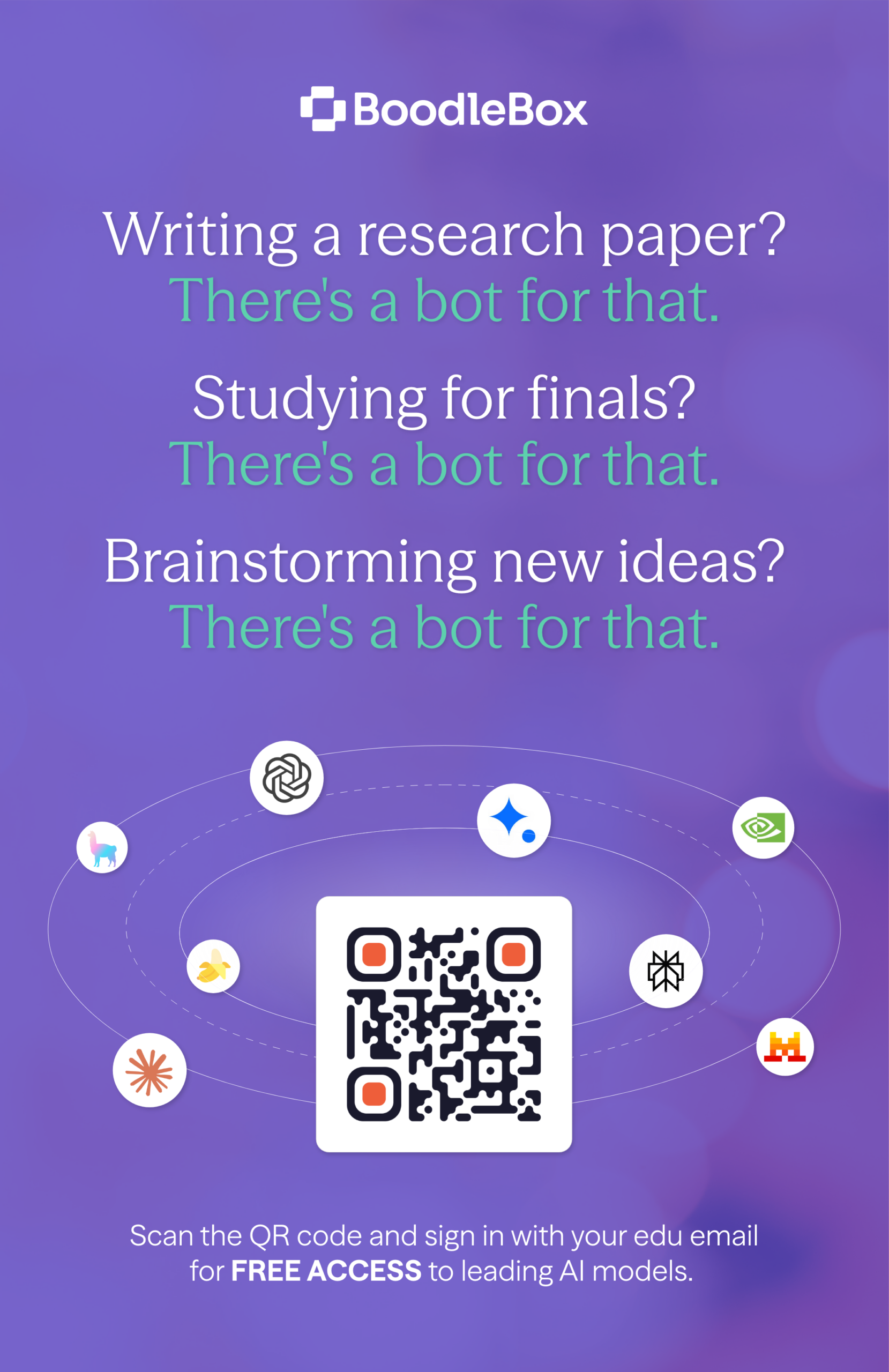
One of several BoodleBox posters provided to participating colleges. (Courtesy of BoodleBox)