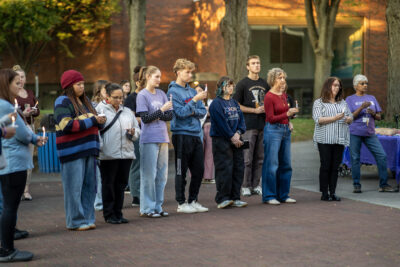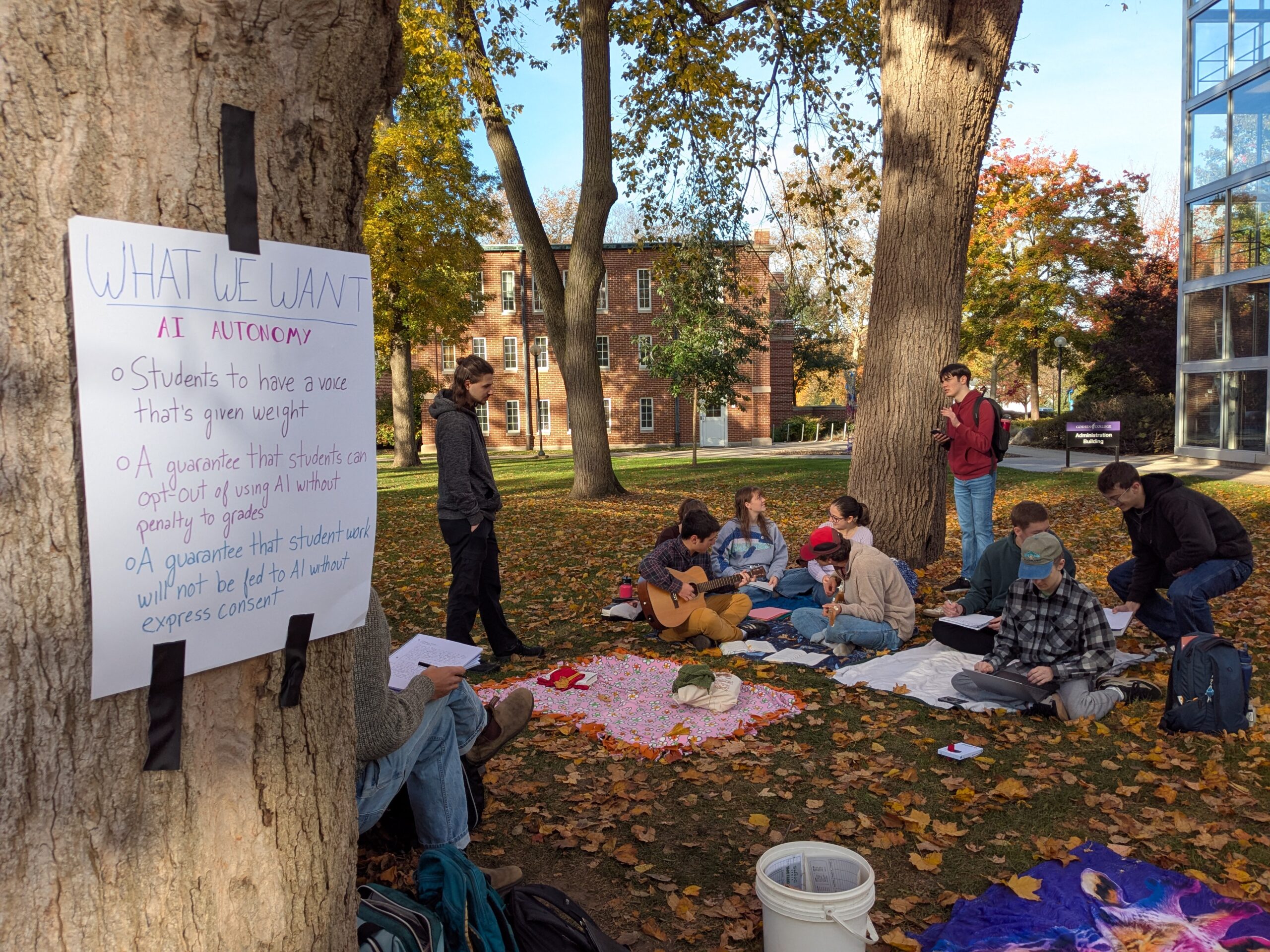

Goshen College’s Peace and Justice Collective invited students, faculty and staff on Saturday to gather on the lawn in front of the Administration Building as a protest advocating for students’ autonomy around AI.
The demands presented by PJC were: “Students to have a voice that’s given weight,” “A guarantee that students can opt-out of using AI without penalty to grades” and “A guarantee that student work will not be fed to AI without express consent.”Attendees were invited to sign a petition agreeing with these demands and to write a letter to GC administration voicing any concerns they had. Over the course of the day, almost three sheets of posterboard were filled with signatures, and around a dozen letters were delivered to President Rebecca Stoltzfus.
Emma King, a junior math and computer science major and a leader of PJC, spent most of the day in conversation with people of differing opinions. “I just want to hear what people have to say,” she said. “It can be very opposing to the actual goal, but I feel like that’s important.”
As a computer science major, there is an expectation for King to use AI in classes, and an assumption that she regularly uses and supports it. She felt these assumptions were evident in convocation on Oct. 28.
The convo was presented by GC’s AI Task Force and featured a panel of students and staff speaking on their opinions of AI. “I was tapped for the potential of being on the panel for that convo because I’m a computer science major. But when I said that I don’t use AI, then they kind of took back that invitation,” King said. “It felt a little bit like it was a biased panel.”
For more information on the convo, look for “GC highlights AI in convo” from The Record’s Oct. 29 issue.
That sentiment was echoed by many who had attended the convo, and was part of why the demonstration took place when it did. Alicia Maldonado-Zahra, GC’s scholar activist fellow, is the faculty advisor for PJC. She said that students came to her after the convo feeling like something needed to change.
“Students were very clear about what their list of needs or demands are. They were very clear about their sentiments,” Maldonado-Zahra said. “It’s not necessarily about whether AI is implemented on campus, it’s how AI is implemented on campus — and it feels very aggressive, very quickly.”
While PJC led this demonstration, many students on campus are worried about the growing use of AI. Dayanara Aguirre-Mulato, a junior nursing major, felt like GC was glossing over some of the negative effects of AI. “It was being presented like a product. … ‘This is good and it’s only good,’ which I think really overbiases the effects of AI,” she said.
AI has been proven to have noticeable environmental effects, most notably in a report released by the United Nations in June. “My view is that the school should not be promoting something that’s literally destroyed the environment,” Aguirre-Mulato said. “Especially with the water supplies being affected … the people in the community don’t have a say.”
Having a say was a strong focus of the protest, as many students felt excluded from any decision-making in their own education. Ella Trudel, a junior interdisciplinary major, said, “I think that people should have the ability to choose whether they use AI or not.”
“I think if you choose to use it, that’s your choice and you should be supported in that. But, if you choose not to, you should have the autonomy to say no,” Trudel said.
Many of those involved in the demonstration are optimistic towards the potential response from administration. Maldonado-Zahra said, “My hope, my desire, my expectation, is that they will be heard. And that students will be invited into conversation with administration. Not to debate, but to engage in dialogue. … If that does not happen, I will be very disappointed and very discouraged.”
King agreed with the hope expressed by Maldonado-Zahra. “I’m quite optimistic. Becky [Stoltzfus] stopped by and talked to a lot of people, and Suzanne Ehst stopped by. They seem very receptive to what we’re saying,” King said. “I have a lot of trust in our administration here, and it feels like issues are listened to.”
Stoltzfus was impressed with the organization of the demonstration. “I think the organizers should be commended. I think it was a great event, and very much in line with the values and cultures of GC,” she said.
Of the three demands listed by the PJC, Stoltzfus connects most with the first: that students should have more of a voice in decisions that affect them. “We need more student engagement. I think the next step of the conversation is saying, ‘What will that look like, and how will we do that?’” she said. “What sort of a voice? … Is it open town forum or open panel discussion? Is it formal representation on the AI governance committee? What is it?”
Stoltzfus also recognizes the split opinions of the GC community. “People are not of one mind about this — faculty are not of one mind, students are not of one mind. So that is part of the community discernment that we have to figure out: … How do we listen to the various voices with respect and understanding?” she said. “We are an organization that needs to address all of those constituents, so how do we move forward?”
Those involved in Friday’s protest acknowledged these struggles. King stressed that she wants to hear from the opposite side. “It’s just important that people continue having conversations about it, and just are willing to talk about things that may seem hard,” she said.
Along with conversations, the protest became a demonstration of community. Throughout the day, guitar and violin music could almost always be heard, as well as hymns. Students used sidewalk chalk to write messages, including a list of GC’s core values.
Card games were played, paper chains were created and laughter rang out across the quad. As Teo Kingsley, a senior theater major who attended the protest, said, “Being human together is a form of resistance.”