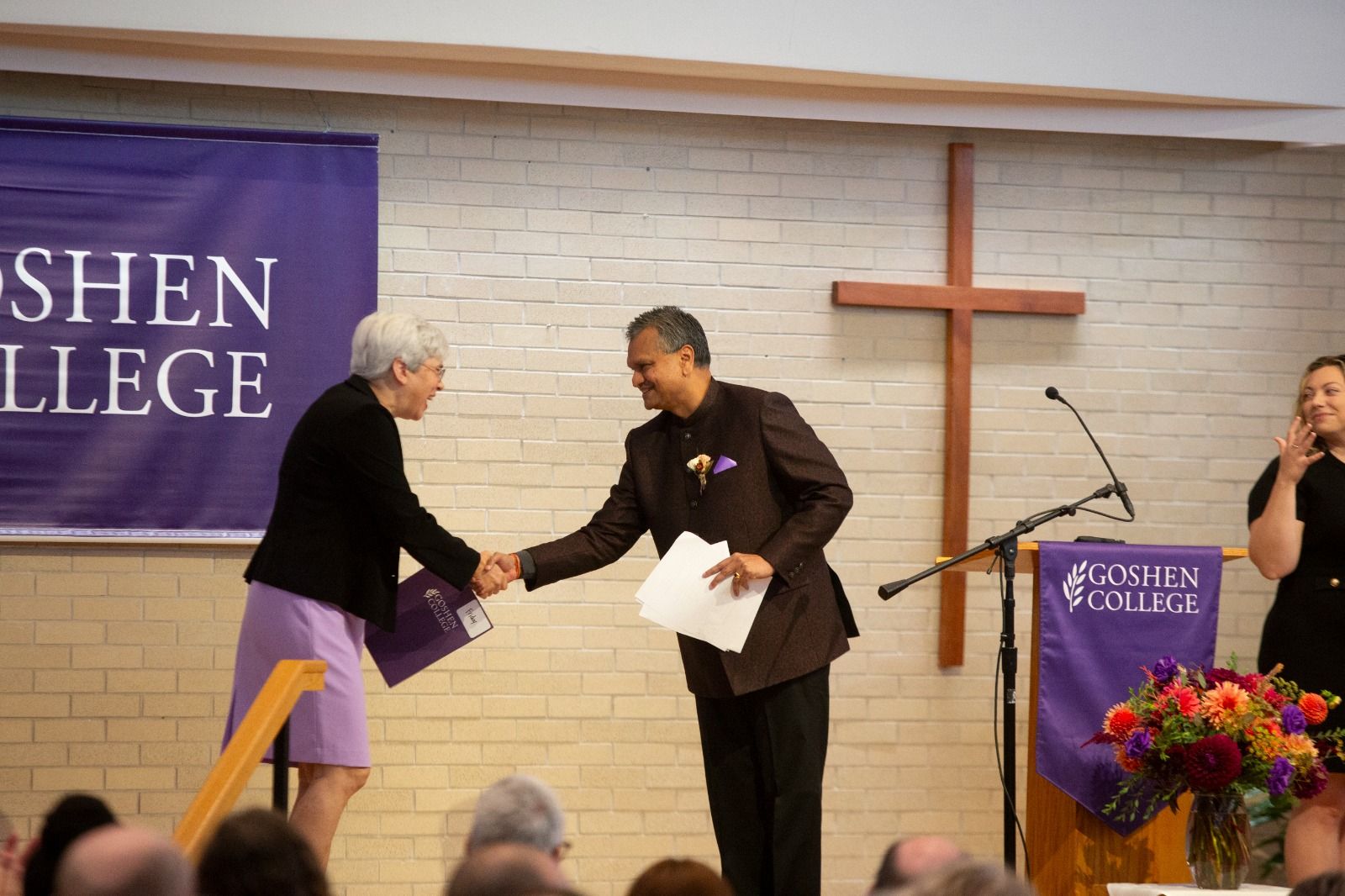

Raj Biyani ’92, after volunteering his time at Goshen College for the newly-created AI Task Force, was hired as GC’s first Chief Innovation Officer, a role which he began on April 1. Biyani has already progressed GC towards the next goal of submitting a grant proposal to the Lilly Endowment Artificial Intelligence in Higher Education Initiative, due by May 1.
GC, which already received $125,000 from the Lilly Endowment after an initial proposal was accepted, is closing in on the finalization of the proposal to receive $5 million in funding. “We’re down to the tweaking stage,” President Rebecca Stoltzfus said. She is also serving alongside Biyani as a co-chair of the AI Task Force. “We’re at the point of just trying to fit [the proposed material] into the parameters of the grant application,” Stoltzfus said.Biyani emphasized the importance of his liberal arts education in his own career and clarified his thoughts around AI and its integration into campus.
“AI, for me, stands for ‘amplify imagination,’” he said. “My job is to provide the environment and the scaffolding to enable others to be able to leverage AI in a way that works best, as opposed to be prescriptive about, ‘Here’s how you’re going to use AI,’” Biyani said.
The task force’s goal is to increase “AI fluency,” which differs from other implementations of AI in higher education. “We define AI-fluent pedagogy as ‘teaching that equips students to engage AI with critical judgment, creative agency and ethical purpose in ways that enhance their lives and contribute to the common good,’” Stoltzfus said.
In an attempt to prepare campus for these impending changes to the GC student experience, the AI Task Force opened up submissions for staff proposals. The faculty’s usage of and questions about AI were compiled to lead the task force on where AI should be emphasized.
“That was Raj’s idea, and it’s part of the planning period, although we may repeat it over time … if we’re successful there. Because it’s part of our planning, we just wanted to figure out what people had the appetite for,” Stoltzfus said. Out of 61 proposals, 45 were accepted, 10 were accepted after resubmission and 6 were rejected.
Specifics of Biyani and the task force’s plans moving forward were not abundantly available, though the proposals shared by Biyani did provide some insight into what the task force is focusing on. Of the proposals accepted, 67% directly benefit students, 47% of projects fall within “instructional innovation,” 16% focus on simulation-based learning, 11% target operational efficiency improvements and 9% build institutional AI infrastructure capacity.
Another change that Biyani has put into process is a rebrand of the communications and marketing office, which will now focus more on marketing rather than communication. The name will be changed to the marketing and communications office to better reflect this priority.
Biyani did not label his future plans for ITS Media and the marketing and communications office, two departments directly under his counsel, as “streamlining.” However, President Stoltzfus did label current changes as such. “[Printing and mailing’s closure] was more about streamlining than diverting dollars. If there are any dollars saved … they won’t be diverted to AI,” she said.
Ashlee Hoogenboom, former assistant director of web and social media content for marketing and communications, lost her job on April 9 as a result of the streamlining process. “Looking back, it was pretty clear from that meeting with Raj, before I was informed, that he already knew … I got a sentence that, as part of the AI restructure, some positions were being eliminated across campus, and this just happened to be one of those,” she said.
Daniel James ’24, the news and media manager for marketing and communications, said, “The greatest asset to our team is the people in it, and the other people that make up communications and marketing.” James could not comment on any employment changes or team reorganization.
Hoogenboom, who is intimately familiar with the technological side of GC’s infrastructure, doubted the college’s ability to transition smoothly to the implementation of the Lilly Endowment grant. “We talk about innovation … I think as a college, as an institution, we might be on the edge of AI, but we have no infrastructure to support that strategic change,” she said.
The unique nature of GC’s culture is fueling the missions being developed that support AI implementation. “We’ve, in essence, turned the paradigm upside down on how most companies and most colleges are thinking about AI right now,” Biyani said.
James has experienced something different from Biyani’s perspective. “For the past year and a half, I’ve been encouraged to learn how to use AI in my writing. … Reading things myself, I think people enjoy reading things that are human-written,” he said.
The task force previously established a divergence from the typical focus on either AI tool discernment or AI efficiency, and Biyani emphasized the student-oriented goals for future AI implementation. When asked about AI’s role in GC’s core values, Biyani said, “My role as innovation officer is not about AI … My job really is to support new ideas. I think it will help us do things better, faster.”
Hoogenboom continuously expressed concerns around the sudden nature of increasing AI implementation at GC. “As a campus that is committed to authenticity and connection between people … it doesn’t feel very good to then suddenly cut people out in favor of unknown AI uses,” she said.
Both Stoltzfus and Biyani maintain that the AI Task Force and grant considerations are keeping in mind the values that define GC. “We want to do what makes sense for Goshen College,” Stoltzfus said.
The task force will submit the proposal to the Lilly Endowment Artificial Intelligence in Higher Education Initiative before its due date on May 1 and expect to hear back from the endowment before the end of the fall semester of the 2026-27 school year.