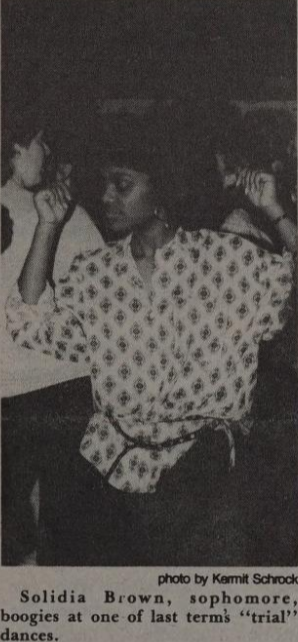

In 1978, nearly 200 Goshen College students gathered in the campus snack shop, now the Leaf Raker, for an evening of disco and dancing. The gathering wasn’t just another student party. At the time, dancing was prohibited at GC, and the event challenged a longstanding college tradition.
In 1983, a forum titled “Off-Campus Parties: Should the Administration Care?” was created. The forum had mixed reviews, with some students agreeing that if the administration was concerned with alcohol, they should allow dances on campus. Some thought that off-campus parties should not concern the administration. Later that year, administration decided not to change the campus dance policy.In 1984, another dance brought debate into focus, this time off-campus. The so-called “Midwest Cultural Seminar,” organized by five students, happened on a Saturday night with more than 350 in attendance. A large majority being GC students.
The dance was advertised through carefully worded signs and two days worth of announcements on the Campus Communicator. Then-dean of students Norman Kauffman, issued a notice about the event, unaware it was an off-campus dance, to which the organizers — in an interview for The Record — thanked him “for the best publicity ever.”
In the same article, Kauffman declared that his main concern was not dancing, but if there was alcohol being consumed.
Some students again expressed concern about dancing policies on campus, arguing that, if they were allowed to dance on campus, the administration would have more control over the alcohol consumption.
In contrast, Todd Friesen ’85 in an interview to The Record said, “If there was someday on-campus dances sponsored by the college, I think there would be off-campus dances and get-togethers.”
Following that event, a series of changes around the dance policy were made. One permitted off-campus dances to be scheduled as official college events with alcohol being prohibited.
Another forum was established, this time including representatives of each residential floor on campus. A student from Yoder 3 said on the forum, “Not enough credit is given to students for caring for and enforcing each other. Many would feel a duty as a friend to talk to a friend who is a problem drinker. In many cases, students are responsible for each other.”
Another student from Coffman 3 said, “The role of the college is not that of a parent.”
In 1986, a trial dance policy was approved by the board. The policy was “partially instigated by a large increase in the number of complaints from the community about loud parties,” according to The Record’s article, “Aspects on Alcohol.”
The three trial dances brought a lot of responses to the then-President Victor Stoltzfus. Some parents addressed the responsibilities that a Mennonite college had to their denomination; one of the letters said, “If we do decide to embrace [dancing], let’s do it because we have found some value and meaning in the moves of our faith.”
In 2011, The Record revisited Goshen’s alcohol policy, with then-dean of students Bill Born explaining that the college maintained an alcohol-free campus. The article also explored how students could face college disciplinary consequences for alcohol-related incidents occurring off-campus.
That same year, the article “Four-year residency: sticking students back in the toothpaste tube?” discussed the implications of ending off-campus housing. One question was raised: “After they are 21, [students] want the freedom to consume alcohol, but because they are required to live on campus and because they are not allowed to drink on campus, these students feel that their freedom to drink is stifled.”
In response, Kate Walker ’11 and Kat Luginbuhl ’11 published an opinion article for The Record.
“As young adults who are over 21, we don’t feel that it is GC’s job to monitor our consumption of alcohol off-campus, or judge our morals concerning a completely legal activity. GC has taught us the values of community, respect and common sense — just because we’re off-campus does not mean we suddenly forget these values,” they wrote.
The discussion about student housing returned in fall 2023, when the college implemented a four-year residential requirement, requiring students to live on campus throughout their undergraduate education.
In response, Sadie Brenneman ’25 published an editorial in The Record titled “Proximity does not build community.”
“The end of off-campus housing almost entirely ended off-campus gatherings. Depending on your point of view, this might sound like a positive shift, like the student body is straightening out. I disagree,” she wrote.
She argued that the policy had not necessarily eliminated partying but had changed where and how students gathered, potentially encouraging smaller and more private social settings.
Brenneman also reflected on the importance of having opportunities for students to socialize outside college-organized activities.
“I think, in general, being able to have the freedom to be with the people in the kind of setting that you’re looking for is something that can’t always be manufactured by the college,” she said.
More recently, a 2026 investigation uncovered previously underreported alcohol violations, raising additional questions about how the college monitors student behavior. In 2025, 65 liquor violations were reported.
Across these decades of policy discussion, students have raised questions about the boundaries of college oversight, personal responsibility and the role of community in student social life.