
Imagine you are at the library working on a research paper that is due tomorrow. You type a few keywords into the library’s search bar, scroll through a list of results and after a few clicks, find exactly what you need. What you don’t necessarily see is everything that has to happen behind the scenes to make those results appear in the first place. For library staff, that process just passed through a transition.
On Aug. 3 The Harold and Wilma Good Library at Goshen College changed library systems, switching their main search interface from WorldCat Discovery to Koha. The change happened on the library’s primary research tool, now including both Good Library and the Mennonite Historical Library’s materials.WorldCat Discovery will now only serve as a tool to locate non-GC owned library material.Abby Nafziger, head of technical services subscriptions and systems who led the team through the migration, said, “The new library management system is part of our collaboration with PALNI, which is a library consortium of 22 other private academic libraries in Indiana. This new set of systems gives us a lot more ways in which we can work with other libraries and more easily share our collections across the system. These changes also make it way easier to learn from other libraries’ experts and try new workflows that will hopefully increase our sustainability going forward.”
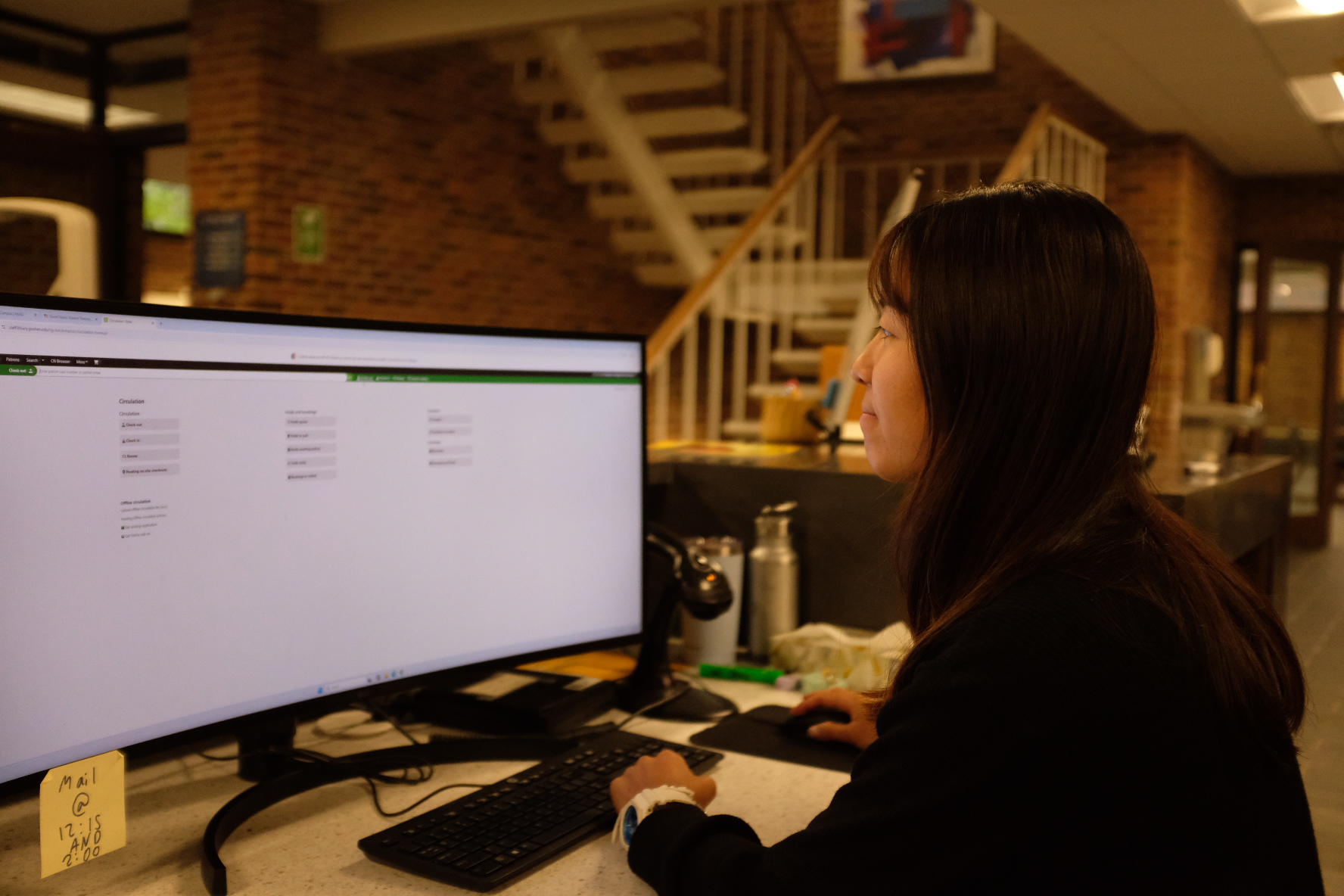
The change will primarily affect the work happening behind the scenes. Peri Mast-Hochstedler, Good Library services assistant and circulation desk supervisor, said, “The student workers have gone through a little bit of a transition in their learning period.”
“I was meeting with students on an individual basis. I would meet with them during their shifts and then go over some of the changes that were happening with Koha in terms of where they need to go to do certain tasks on the library’s website,” Mast-Hochstedler said.
The change will make library holdings -–– e-books, journals, articles, books and video games — more discoverable to patrons. Nafziger said, “Our old system really prioritized searching everything available worldwide, which meant that sometimes patrons would miss the high-quality curated resources we already own and have immediately accessible.”
This includes material from the MHL that now will be included in the same research tool. “The MHL holdings are a world class research collection with a primary print focus, so the fact that they were separated was a long running source of frustration … I hope this will help more patrons discover the ways in which they can use the MHL’s extensive Anabaptist collection to do important research on both a local and global scale,” Nafziger said.
While finding materials owned by GC has become easier, locating items that the college does not own can be more difficult. However, there are two primary ways patrons can make it easier to find and request specific books or articles. “The first is that you can remove the filters that limit your search in EDS [EBSCO Discovery Service], and that will show you records outside of what we own. Or, if you are looking for the title of a particular book, you can scroll down to the bottom of search results and connect to Worldcat, which easily connects to ILL [inter-library loan] and allows you to request almost any book or article,” Nafziger said.
The process behind the scenes has also become easier for library staff. In the past, interlibrary loan materials had to be processed, placed on the shelf and followed up with manually written emails to patrons. Now, those steps can be handled automatically through Koha. Once an item is processed, the system sends patrons a notification that their book has arrived, sends reminders to pick it up and tracks how long it has been on the shelf. Mast-Hochstedler said the automation has been a “huge time saver” for library staff.
The change has also helped reduce the impact of mistakes made during the interlibrary loan process. Because Koha and the ILL system are kept separate, errors made within the library’s system, such as entering the wrong due date, can be corrected without affecting the ILL records. In the past, mistakes could require staff to contact the other library to resolve the issue: “It added a lot of steps to the process,” Mast-Hochstedler said. Now the two systems mean staff can correct errors on their own.
Overall, the new system has simplified several of the tasks library staff handle behind the scenes. “We’re still going through a transition period right now. There might be some links on our website that are out of date — that still go to the old system — that might not work anymore, so we’re still trying to update things on our website as we go along and trying to catch everything that’s still out of date … but we’re doing pretty okay. The transition went a lot smoother than anticipated, that’s for sure. So we definitely did it at the right time,” Mast-Hochstedler said.
The next time you sit down to research a paper, you may once again type a few words into the library’s search bar, find a source and move on with your work. The search itself may not reveal the changes that have taken place behind the scenes, but for the library staff, the new system has changed the work that makes that simple search possible.