
agriculture
February 2, 2017
Radical garden, epic harvest
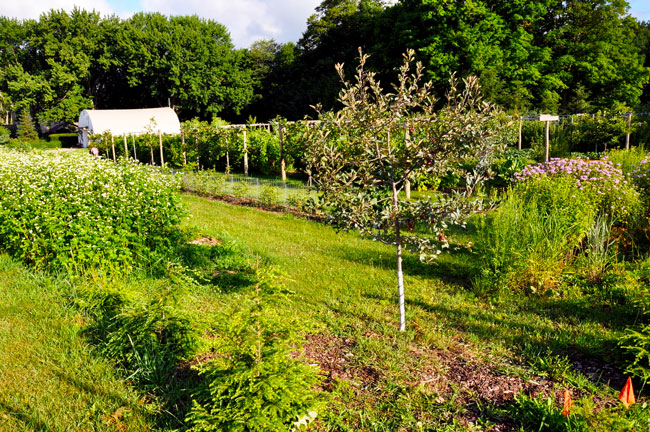
Luke Gascho, a vibrant Goshen citizen, rejects the idea of hibernation. “This morning, as part of my breakfast, I had blueberries, raspberries, strawberries, cantaloupe and currants, all that we had frozen,” Gascho said. “And that’s every morning.” It’s the middle of winter in Indiana: a bleak, grey sky the norm for the next few months. The average Goshen resident slips into a pseudo-hibernation, taking asylum within homes, refusing to brave another day without sun. Gascho is a radical gardener, transforming his home and garden at the corner of Kercher Road and Route 15 into a smorgasbord of growth. Adjacent...
November 10, 2010
Jackson challenges traditional agriculture in public address
If current global economic and agricultural trends don’t change, the results could be disastrous for the earth. This might not be a groundbreaking statement, but it’s one that has come into the spotlight at Goshen College since Wes Jackson addressed students and community members Tuesday night in Sauder Concert Hall. Wes Jackson, author and founder of The Land Institute, spoke on Tuesday evening in Sauder Hall about his vision of a better global agricultural system. He said the popular mindset, “Nature should be subdued or ignored,” is one of the main reasons for the historically poor land stewardship by people....
November 2, 2010
Wes Jackson to speak on agriculture measured by nature
Wes Jackson, an activist for sustainable agriculture and president of The Land Institute, will speak in Sauder Concert Hall November 9th at 7p.m. Recognized by Smithsonian as one of “35 that made a difference,” Jackson will lecture about "The Necessity and Possibility of an Agriculture Where Nature is the Measure." There is no cost to attend. Jackson seeks to address the future of agriculture by looking at the past. Years ago, a variety of plants and insects could be found in prairies. But now in fields across North America, farmers are growing only a single crop, a practice called...
February 18, 2010
Dahlia History and Care–Sidebox
Dahlias originate from tubers, which are similar to potatoes. The tuber grows underground and sprouts offshoots that can multiply the number of plants that appear above ground. The flowers can appear in reds, oranges and yellows as well as pinks and whites. The plants are then classified by the size of the blooms, which can range from less than 2 inches to over 10 inches. There are then 11 different flower shapes. It is best to plant dahlias between April and May. They need direct sunlight and consistently damp soil. The flower blooms become more beautiful if the dead blooms...
February 18, 2010
A Business that Blooms
By day Jerry Schoenauer gets his hands dirty with the pipes of Goshen College’s toilets, showers and water fountains. He sends out orders for new pipes that will replace the damaged ones and makes sure the water runs in the right direction. However, when evening arrives, Schoenauer finds himself among the red, orange and pink dahlias in his back garden. After talking to a friend on the subject of gardening, Schoenauer attended a dahlia flower show at the Concord Mall. He still remembers taking in the scene: hundreds of dahlias in reds and peaches and purples and pinks. “From there,”...