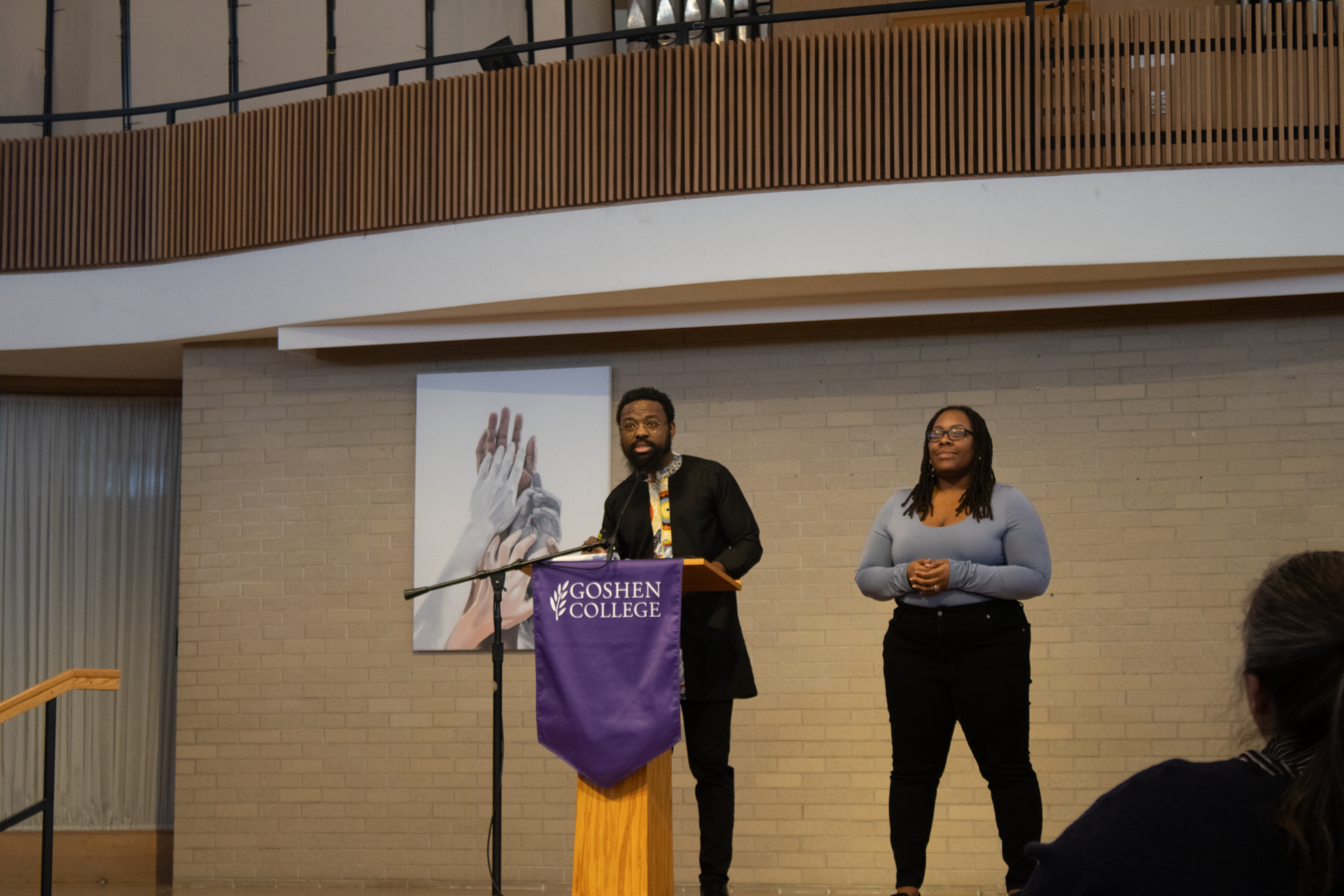

Jan. 19, otherwise known as Martin Luther King Jr. Day, saw all regularly-scheduled classes and events canceled. In their place, Goshen College invited Dr. Steven D. Parker to speak at the morning’s convocation, host workshops and hold group discussions revolving around racial inequity and critical race theory.
Compared by Parker to the rich diversity that can be found even amongst a forest of solely pine trees, Goshen is a place where the extensive natural diversity of humanity can be found, even in the small sample size that it is. This, along with the Midwestern roots of Goshen and Parker, are both reasons Parker was driven to make his mark on campus. “Goshen is a magical place … And when I tell you this place is a cultural place saturated in diversity, I mean it,” he said.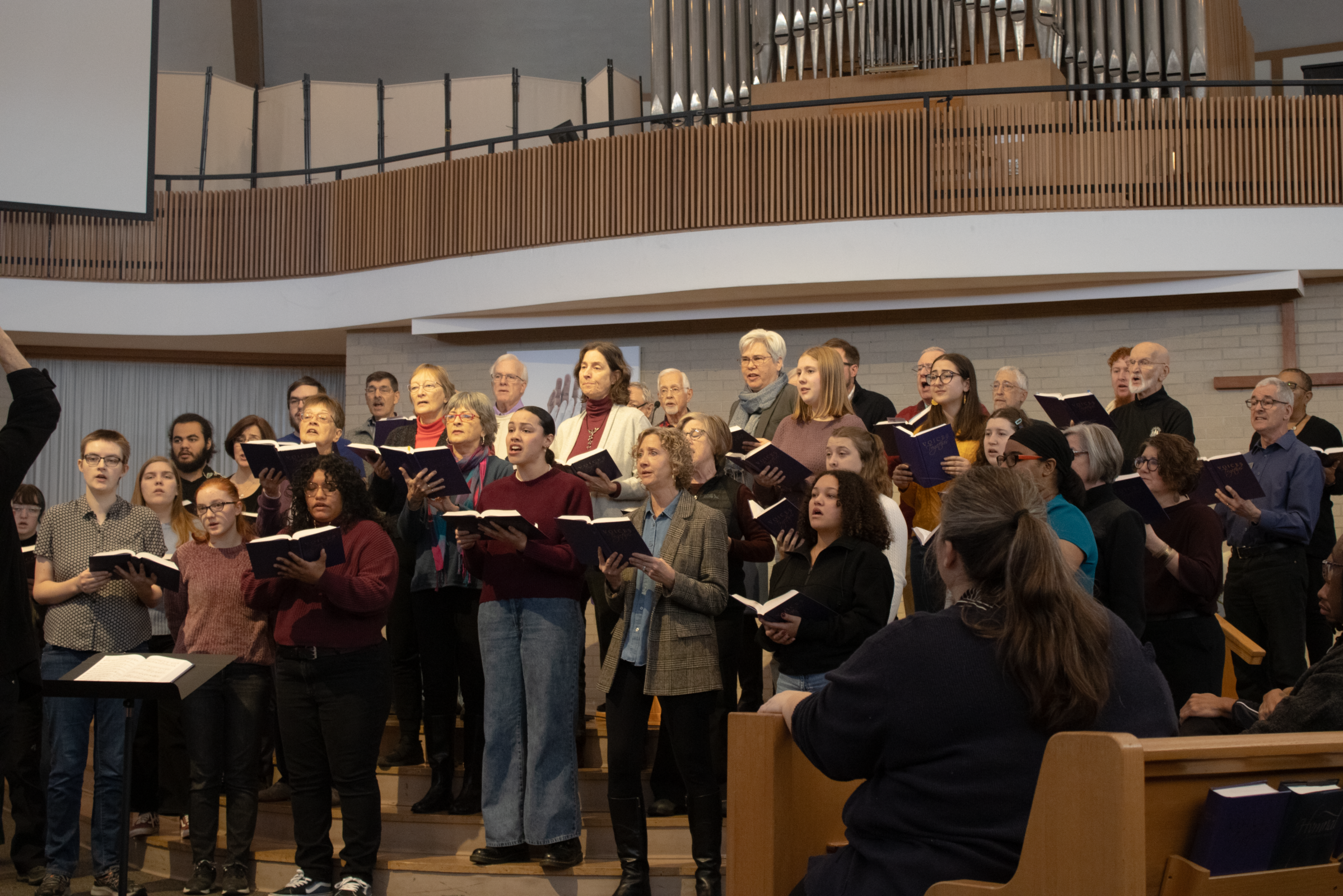 A Chicago native, Parker came into his work through his curiosity as a child on why things were different for him. “[My parents] were never telling me the full truth — that there is an actual social construct put in place to harm me … and that thing is race,” he said. He continued to ask questions as he learned more. “‘Why is that different? Why is that different? Why is that different?’ … But when differences disproportionately didn’t benefit [some] people or benefitted others, I had a problem with it,” he said.
In his initial contact with the GC campus through the early convocation service on Monday, Parker spoke on different aspects of the inequities in the modern landscape. He talked about the realities of today’s highly opinionated politics, and brought new ideas to the forefront of listener’s minds. Parker proposed what he calls “helperism.”
“We should think of it as its own discipline,” he said. He explained that there are different subsets of helperism: bystanders, allies, advocates, change agents and abolitionists are all ways of helping. “It gives us the structures and the definitions to engage in change.”
In a workshop that expanded on the topics of his early presentation, Parker highlighted the five pillars of CRT: centrality and intersectionality of race and racism, challenge to dominant ideology, commitment to social justice, centrality of experiential knowledge, and interdisciplinary perspective. “[Dr. Martin Luther King Jr.] was a human who was transdisciplinary. He leveraged education, spirituality and advocacy to change the world as we know it, but he was a glimpse in time that we try to staple into our reality today,” Parker said.
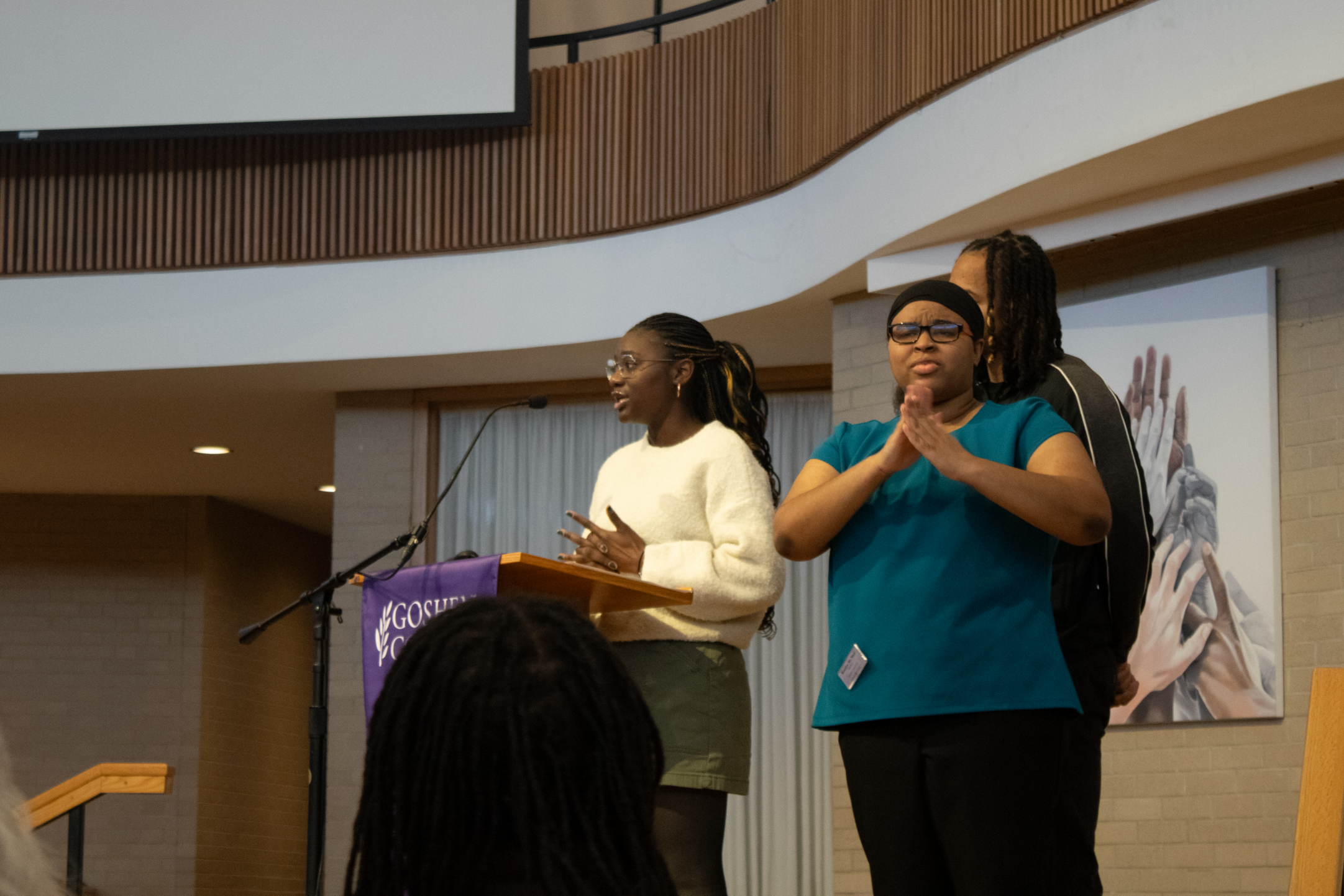
An annual MLK Day celebration is marked to remember the man and the values he stood for. Parker continues to serve the people that are experiencing unequal existences, with the ideas needed for modern reality. “We find ourselves, ever so quickly, getting to a space where we devalue, disregard … and denounce what [King] stood for. We see that reality before our very eyes in this current political climate.
“King would’ve been out in the streets going wild with Renee Good, so if King was alive and that brother would still be doing it today, that means we ain’t changed much. That means that King’s holiday is ornamental,” he said.
Continuing to protect and ensure equal representation in all aspects of life is something that Parker has been building since he first decided to study social work, a field where he felt he could help numerous lives.
Throughout multiple presentations, Parker stressed the importance of human rights, inherent worth and liberation. Though Parker cited King as
one of his most important thinkers, he also credited the work of many others that often goes unsung.
“There are other people that are critical thinkers like Derek Bell, a critical legal scholar, there’s also John Lewis, … amazing human and was able to tell some truths. … There are other people that bring me great joy as well, and some of these people have lost their lives,” he said.
Parker also hoped to leave GC with what he thinks to be an important, but troubling message. “It saddens my heart that this is what I want to leave people with, but it is the truth. All humans are inherently worthy of existing, and no human gets to dictate our worth,” he said.