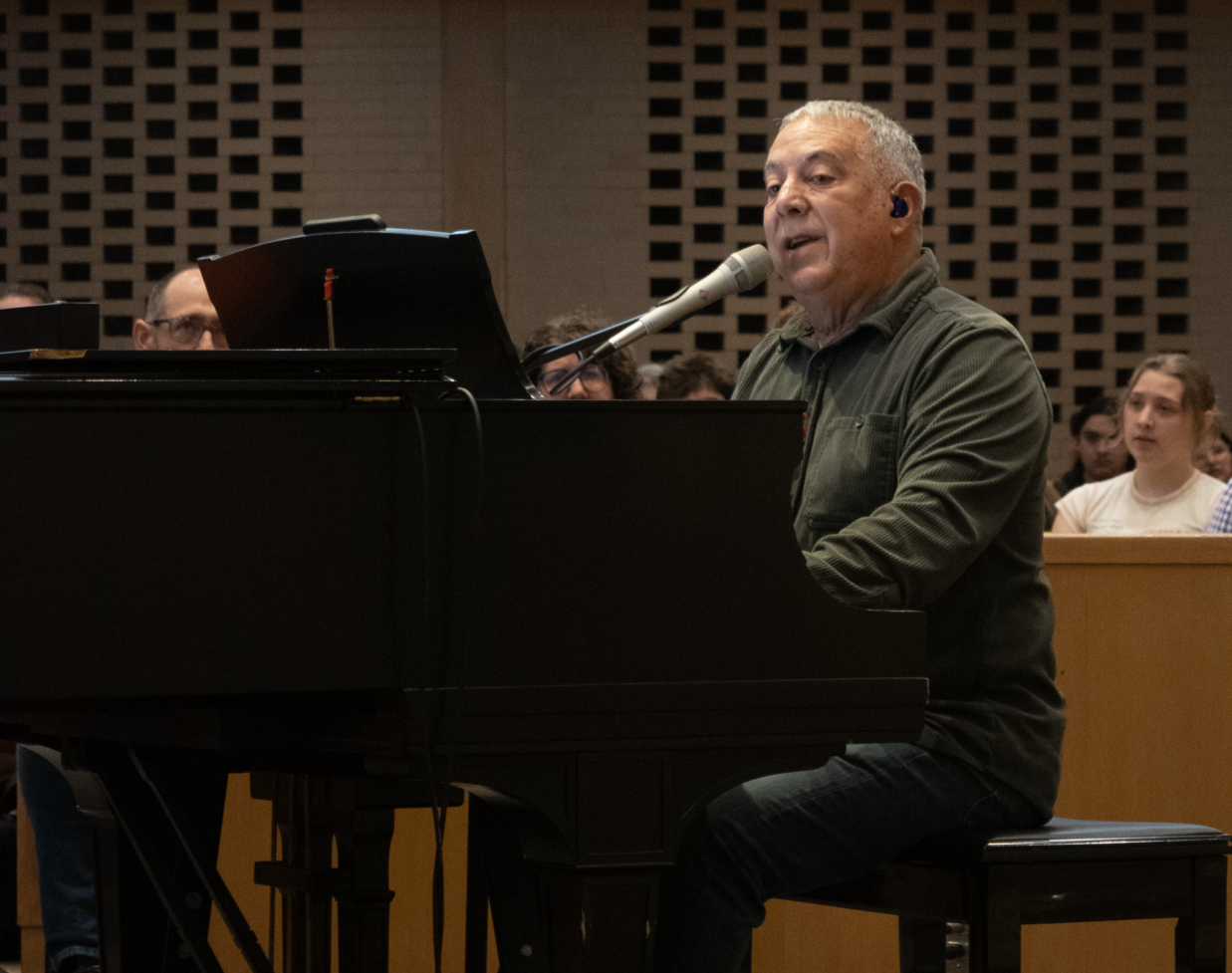

Upon walking into Wednesday’s chapel, students were met with a somewhat unfamiliar sight: the space was arranged for a concert, with the Steinway piano and several microphones moved into the center of the room. The occasion was a show put on by Fernando Ortega, an award-winning singer-songwriter of contemporary Christian music from Albuquerque, New Mexico.
Ortega was set to perform in Sauder Concert Hall later that day for the Performing Arts Series. He agreed to do another show earlier in the day during the usual chapel time. In the past, PAS artists have done various kinds of educational events and masterclasses, but it is far less common for them to perform at a chapel like this.Over the course of the concert, Ortega played a variety of worship songs — both covers and originals — with Cara Fox, a Nashville-based musician, accompanying him on cello and vocals. Between songs, he shared stories from his own life that ranged from a heartfelt account of his own struggle with panic attacks to a tale of a traveling preacher falling into an open grave that had students laughing out loud.
Commenting on those anecdotes in an interview with The Record, Ortega smiled and said, “Yeah, I have a lot of weird stories.”
Miguel Aguilar, a sophomore business major, enjoyed the stories and said, “It was just him sharing his little part of life while also having fun with it.” Aguilar also spoke on the format of the music and the chapel as a whole. He said, “I think it was great to have a different experience from what we’re kind of used to.”
While the show brought something new to chapel, Ortega’s genre brought its own change as well. Jeshua Franklin, music center executive director, said, “We don’t have a tradition of having Christian music artists on the Performing Arts Series.” Franklin said that he is curious if this is a niche that he and his team hadn’t explored and would resonate with the Goshen College community.
Franklin spoke highly of Ortega’s ability as a musician. Every artist who visits GC has different priorities and requests, and in this case, Franklin said with a laugh, “The main question is, well, what kind of piano is there in the chapel? … And fortunately Goshen has a beautiful Steinway.”
For his part, Ortega said that he enjoyed the experience. “I’ve played a lot of chapels where I was on a stage and everybody’s out there. But to have everybody surrounding me … it was unusual, and it was fun,” he said.
Ortega said that he prefers to be in a more controlled environment when he’s performing live. “I don’t like to wing it too much. I plan every song I’m going to do.” But, he added, “Sometimes the Holy Spirit does prompt you. And I felt like that this morning, that’s why I switched gears and changed songs.”
Ortega has loved music since he was 6 years old. His neighbors moved away for a time and left their piano with Ortega’s family. He said that he was immediately drawn to it. “I could play by ear pretty well when I was a little kid. Not so much chords, but I could pick up melodies and TV theme songs and stuff like that.”
From there, he became a classically trained pianist. Ortega said, “By the time I was a senior in college, I was determined that I wanted to be a classical, like, a concert pianist and play concertos with orchestras and everything.”
One of the major defining features of his journey came when he and his then-girlfriend went to the East Coast to audition at several major schools of music. Ortega had a friend who was attending the Juilliard School in New York City and let him into the practice rooms there.
He was in one of those rooms, practicing Chopin’s Ballade No. 3, when suddenly he noticed the same piece being played somewhere down the hall.
“So I kind of snuck down the hall and peeked in this room.” What he saw came as quite a shock. He said, “She must have been a 12, 13-year-old girl. Like, her feet didn’t even really reach the pedals, and she was just an amazing piano player.”
Ortega said, “I felt like, in that moment, it conked me on the head and kind of showed me that I was a good pianist, but I was by no means a world-class classical pianist.”
Ortega’s auditions after that did not go the way he had hoped. He was offered a place in the composition theory department at one of the schools he applied to. Ortega was set on performing, so he turned down the position. “I was so proud, too proud,” he said. “So I went home and I was real depressed for a couple of years and hardly touched the piano.”
However, it was because of that experience that he found himself playing in his church, which led to the connections that started him into his present career.
“Sometimes God does that to us,” Ortega said simply. “The way He deals with us is with negatives, you know, you have those experiences.” Thanks to starting down that musical path, he has since recorded 23 albums and is presently working on another.
In the hallway after his interview, Ortega paused in front of the wall of signed photographs that documents many of the musicians who have played in Sauder Concert Hall before. He pointed at several of the artists and remarked on having known them, some even as close friends.
Ortega said that God had used those events to put him where he needed to be. He said, “[It knocked] me off the course that I wanted to be on and onto the course that He wanted me to be on.”